The Efficiency Bloc

How to Turn Dispersed Competitors into a Unified Market Force.
In Northwestern Ontario, we faced a structural paradox. Fourteen fly-in communities spread across thousands of kilometers operated under a single, limiting belief: If Community A hired a physician, Community B lost one.
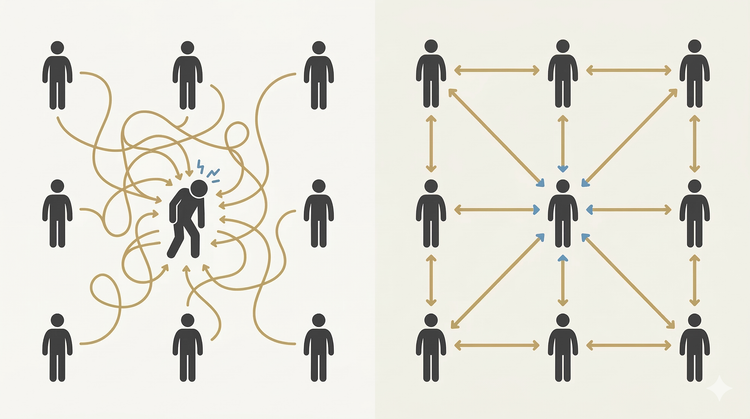
This belief created a "Zero-Sum" culture. Recruiters withheld data, rates, and candidate profiles, fearing that sharing information would compromise their local advantage. The result was a fragmented system where every site operated in isolation.
As the Regional Advisor, I had a vantage point the individual sites lacked. I could see the pattern. Every community was facing the exact same operational friction: housing delays, credentialing bottlenecks, and travel logistics. The challenge was not the community down the road. The challenge was the supply chain itself.
When you misdiagnose the constraint, you build the wrong strategy.
PART 1: THE ZERO-SUM FALLACY Traditional recruitment logic assumes scarcity. It relies on higher incentives and faster offers to "win" talent. In an urban market, this competitive friction is normal. In a remote network, it is inefficient.
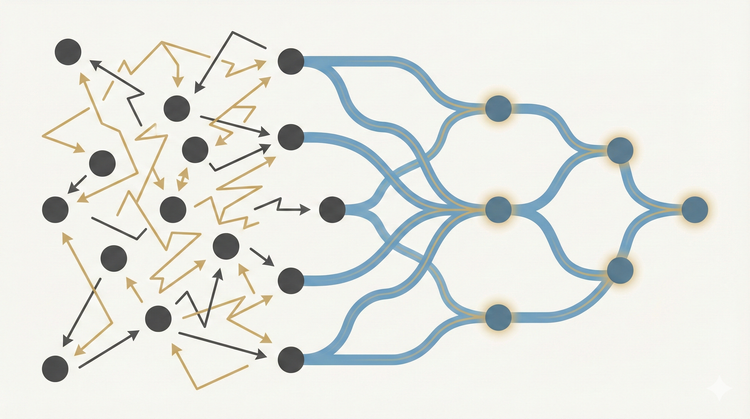
When independent sites compete for the same resource pool without coordination, they drive up costs and fragment the candidate experience. What appeared to be a hiring problem was actually a network design failure.
PART 2: THE FACILITATION STRATEGY You cannot mandate collaboration in a decentralized system. You have to demonstrate its value. My approach was to create a neutral environment for transparency.
I invited all fourteen community representatives to a regional session. We removed the "institutional" barriers and focused on day-to-day operational realities. As the discussion progressed, the silos dissolved. The group realized they were navigating the exact same systemic hurdles.
The shift was immediate. The focus moved from "protecting territory" to "solving the process."
PART 3: THE DATA ENGINE Once the operational alignment was established, we moved to data aggregation. Previously, the provincial narrative suggested that retention rates were stable. However, this was based on high-level metrics that masked regional nuance.
Our new "Efficiency Bloc" aggregated ground-level data from all fourteen sites. The unified dataset revealed significant recruitment & retention gaps that were invisible at the individual level.
We simply presented the clean, unified data. This clarity forced a strategic realignment at the leadership level, resulting in new roles and funded infrastructure designed to address the specific gaps we identified.
PART 4: SCALING THE STANDARD The most important shift was moving from "Individual Heroics" to "Systematic Infrastructure." We built a recruiter-driven network that relied on shared standards rather than personality.
- Shared Locum Pools: Reducing administrative redundancy.
- Standardized Onboarding: Improving the provider experience.
- Centralized Coordination: optimizing travel and housing logistics.
Counterparts in Southern Ontario later adopted this framework to build their own regional networks, and the model was studied by international researchers as a benchmark for rural stability.
THE PROTOCOL Dispersed organizations fail when they believe they are in competition with themselves. They succeed when they align around shared infrastructure. The job of a modern operator is not just to acquire talent; it is to redesign the ecosystem so that talent can thrive.