Capacity Is a System Property, Not a Hiring Problem
When organizations face persistent staffing shortages, the instinct is almost always the same.
Post more jobs.
Increase recruiter activity.
Expand sourcing.
But in complex systems, capacity rarely fails because of effort.
It fails because of design.
The Illusion of the Hiring Lever
Most leadership teams treat recruitment as a faucet.
Turn it harder and more candidates should come out.
But healthcare, retail health, and multi-site networks don’t behave like faucets.
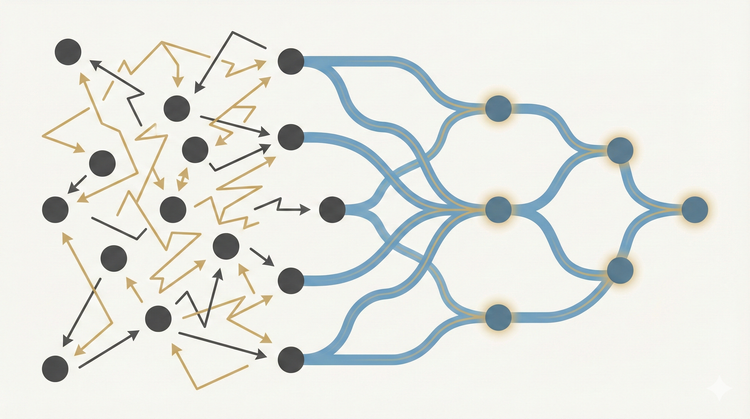
They behave like ecosystems.
Adding more input to a constrained system doesn’t increase capacity.
It increases turbulence.
More interviews.
More partial processes.
More candidates stuck in slow pipelines.
The organization believes it is “trying harder.”
The system simply becomes noisier.
The Throughput Question
In high-constraint environments, the real question isn’t:
“How many candidates are we attracting?”
It’s:
“How smoothly do candidates move through the system once they arrive?”
Throughput is the true capacity metric.
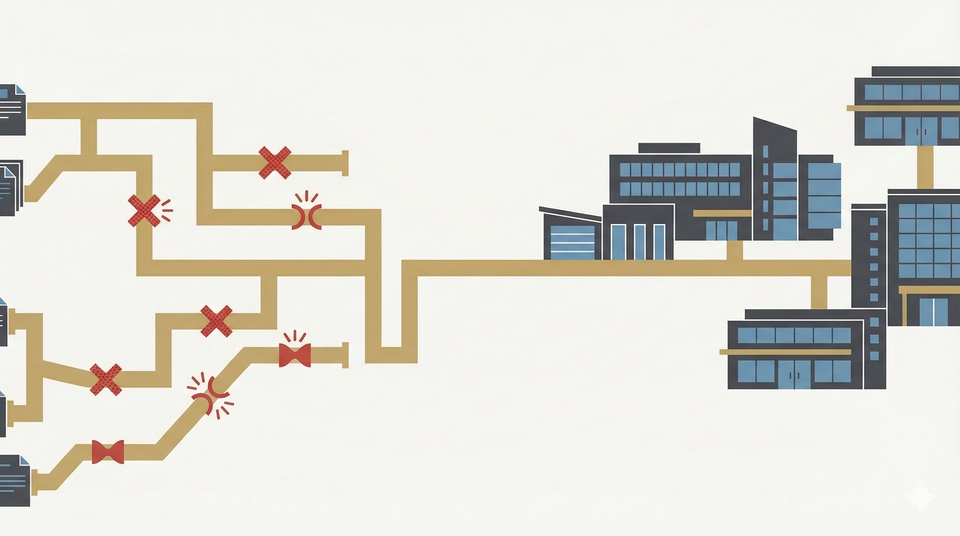
And throughput is controlled by friction.
Where Systems Break
Across distributed networks, friction almost always hides in the same places:
Decision latency
Multiple leaders reviewing the same candidate without clear ownership.
Process duplication
Credentialing, paperwork, or onboarding steps repeated across sites.
Structural restarts
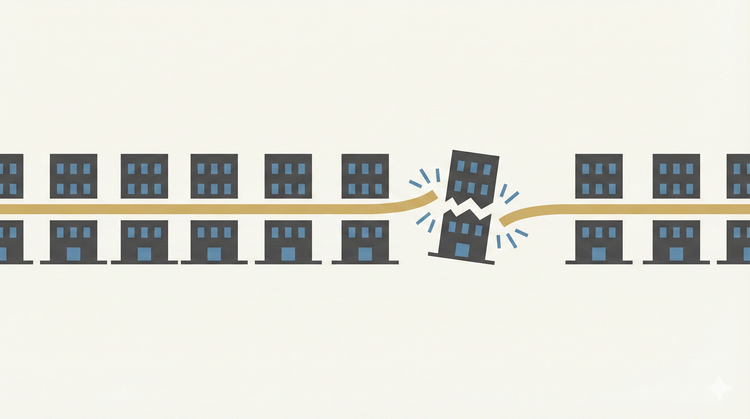
A candidate rejected at one site must restart the entire process elsewhere.
Operational uncertainty
Candidates cannot visualize what their first months will look like.
Each of these moments slows the system.
Individually they look small.
Collectively they slow throughput.
The Architecture Shift
Instead of asking:
“How do we hire more?”
Ask:
“How do we reduce friction inside the system?”
Three architectural moves changed the dynamic.
Flow Before Volume
We stabilized internal processes before increasing sourcing.
Decision timelines were clarified.
Candidate ownership became explicit.
Handoffs were defined.
Once flow improved, the same number of candidates produced more hires.
Network Routing
Candidates stopped being owned by individual sites.
They became assets of the network.
If a candidate didn’t fit one environment, they were redirected to another without restarting the process.
The system began retaining talent instead of leaking it.
Predictable Onboarding
We standardized the first weeks of employment.
Clear expectations.
Clear communication cadence.
Clear operational support.
Acceptance rates increased simply because uncertainty decreased.
The Compounding Effect
When friction drops, systems behave differently.
Throughput increases.
Word-of-mouth improves.
Returning clinicians become common.
Recruitment stops feeling like constant emergency response.
It begins to look like infrastructure.
The Executive Lens
If you manage a distributed network, the key question is not:
“How hard are we recruiting?”
The question is:
“How easy is it to move through our system?”
Because when systems flow well, capacity rises naturally.
And when systems stall, no amount of recruiting effort can compensate.
Capacity is not created by activity.
It is created by architecture.
EXECUTIVE SUMMARY
The Problem
Organizations treat hiring as an activity problem rather than a system constraint.
The Shift
Focus on throughput and friction reduction inside recruitment infrastructure.
The Outcome
Higher hiring efficiency, improved acceptance rates, and scalable capacity without increasing effort.